In 2001, Electric Minds, one of the early experiments in virtual community, went dark.
Those of us in the community weren't ready to let it go. We kept it alive...a community built around human conversation, not engagement metrics.
And now, it's back again, in the form of Electric Minds Reborn.
In the Trenches with Electric Minds
Founded by Howard Rheingold, author of the treatise The Virtual Community, Electric Minds sought to put his concepts of online community into practice. Rheingold was a longtime member of The WELL, one of the pioneering pre-Web online communities, and he deliberately structured Electric Minds in a similar fashion, even using the WellEngaged conferencing software (a derivative of the WELL software) to run it.
In the late 1990s, Electric Minds was acquired by Durand Communications, an Internet company from Santa Barbara, CA, which had been developing its own "CommunityWare" platform for hosting virtual communities. We made CommunityWare's conferencing work just like that of WellEngaged, and kept the community alive. I worked there at the time; I helped make it happen, and I got to be part of the resulting community.
By 2001, Webb Interactive, the new parent company of Durand, needed to shut down the old CommunityWare platform. What happened next wasn't planned:
At the end of December 2000, we got the notice that
Electric Minds, and all of WebbMe, had one month's life
left. On January 31, 2001, Webb would pull the plug.
The reason was, they needed the servers that WebbMe was
running on to deploy new services for paying customers,
and there was no space left in the NOC.

It was New Year's Day Weekend, 2000/2001, when I began
working on Venice in earnest. I had toyed with the
idea of an open source CommunityWare-style platform
earlier, but hadn't done much about it besides make a
few notes. Now I set up a basic MySQL database layout,
installed Tomcat on our home file server to act as a
test platform, and began building some quick prototypes,
which were later rewritten into the code that exists
today.

As promised, Webb pulled the plug at the stroke of
midnight, Mountain Standard Time, February 1, 2001,
after a night that will long be remembered as "the
greatest squanderfest in history." Following that, the
community huddled in its private conference at Cafe
Utne while my wife collected donation checks towards
our new server and I sweated mightily at the keyboard,
churning out thousands of lines of Java code. (The
server cost $1,337.98; we raised that money in just
1 1 /2 months.)

After we got the server, it spent several weeks on the
floor of our computer room having its operating system
and basic software installed, while we looked for
hosting options. We had originally planned to host it
at Webb, but that solution proved to be impractical,
and Andre's backup plan to host it at a local ISP he'd
invested in also fell through (as the ISP had gone out
of business). Fortunately, <Dozer> stepped in with his
hosting offer, and I was soon packing the server up and
having it shipped via UPS to San Francisco. <Dozer>
also took the precaution of registering the domain
electricminds.org, which we will probably be using as
our "permanent" domain from now on.

Once the server was in position, I loaded the first
"complete" version of Venice onto it, and we began a
beta period that lasted some three weeks, and only
ended on Saturday when I switched the configuration to
a new database and renamed the site as Electric Minds.
That night, <wolfee> pointed minds.com to the new
server, and we were off and running.

And that brings us up to today.
A Community Rebuilt
I wrote that in April 2001, in the new version of Electric Minds, on its new server. It was the culmination of the work we'd done to rescue the community, and give it a new home, right down to its new software, the Venice Web Communities System.
For the next five years, this server was home. Home to lively discussions at all hours and around the world. The virtual drinks never ran out at Socrates Bar & Grill, yours for the price of a quote. People connected in the Electric People conference, dove into deep topics in Altered Minds, debated the issues of the day in Speaker's Corner, and engaged in wholehearted merriment in The Playground. Relationships blossomed; EMinders who had left this Earth were mourned; milestones were celebrated. Venice kept improving as I continued work on the code.
Eventually, it went dormant again...a new server and new hosting weren't enough to keep it alive, and many were seduced by the siren call of the up-and-coming social media.
Third Time Reborn
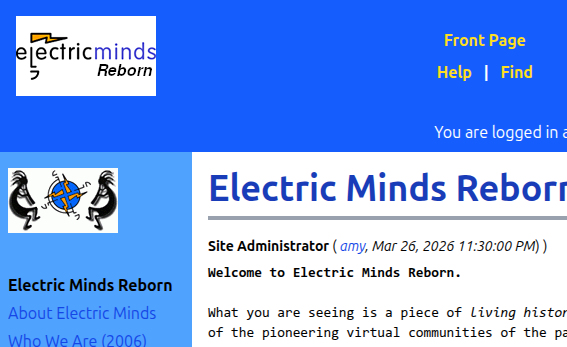
Now, Venice has been rewritten again, in the form of the Amsterdam Web Communities System. And this code is now running on the new Electric Minds Reborn. But this site is more than just a technology demo; it contains the history of the 2001-2006 Electric Minds, as a living archive of the history of a real community.
From here, it may point a new way forward.
Large social media platforms promised connection at scale. In practice, they centralized control and turned communities into products.
Electric Minds was something different: a human-scale community where the participants, not the platform, defined what it became.
Maybe it’s time to try that again.
We're already seeing this conversation happen now, with the advent of distributed social media, the IndieWeb, and smaller-scale sites of all kinds. Amsterdam should be a part of this conversation...because it shows a model that worked, and can work again.
Right now, Amsterdam has all the functionality of Venice circa 2006. But it won't stay that way. I have plans to implement more modern techniques, to evolve the model to modern standards without losing sight of what made it special.
Electric Minds Reborn is both an archive and a living space. You can read what came before...or help shape what comes next.
"What it is, is up to us."